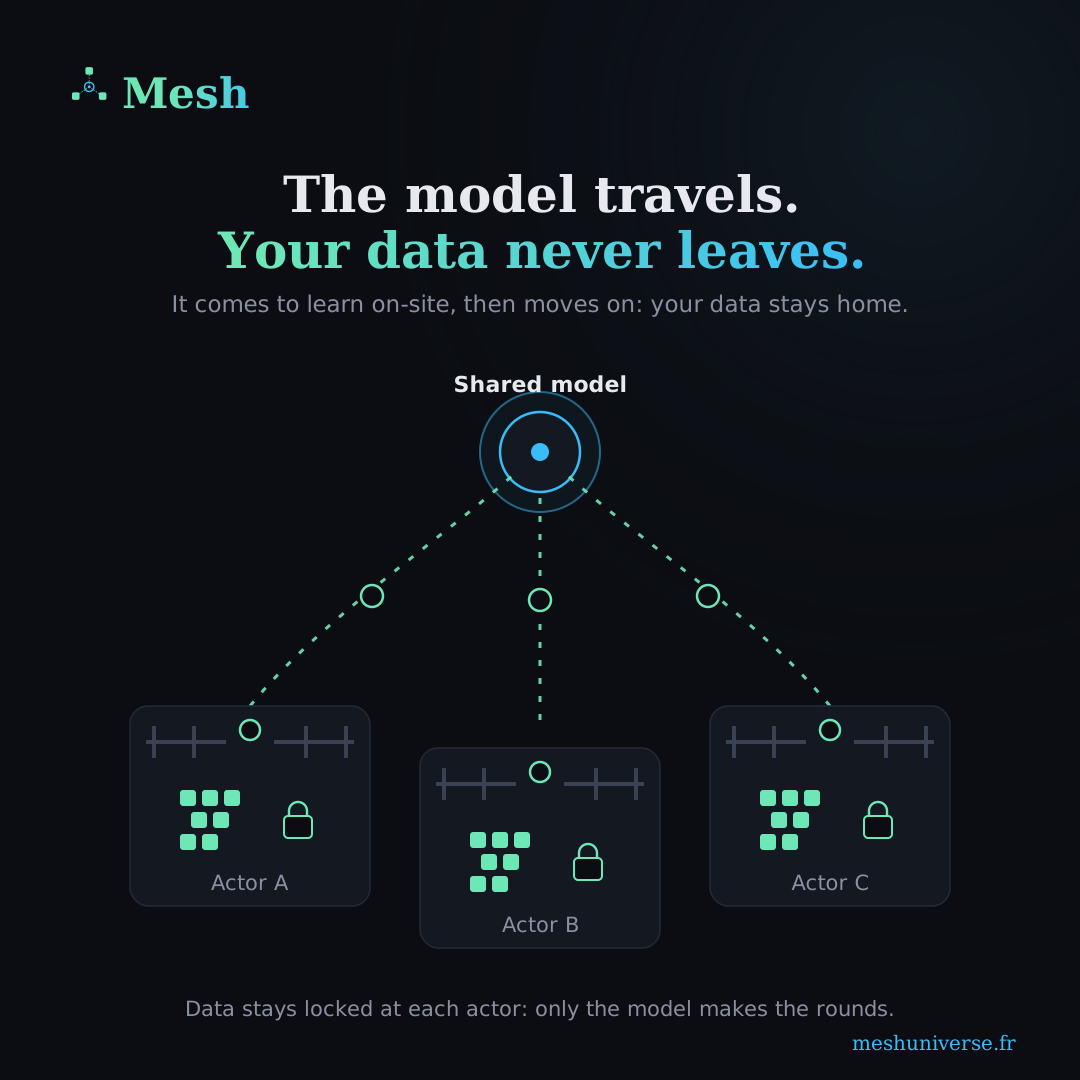
Collective intelligence, everyone’s confidentiality. Several organizations want a shared model, none can hand over its data: the project stops before it starts. Mesh gets it started. An AI trained by the collective, without any data ever leaving home: only the model travels, end-to-end encrypted.
Training runs on your side. Raw records never leave your infrastructure.
On our real public datasets, the collective model gains 6 to 8 AUC points over the average of what the actors get alone, without any data being gathered anywhere.
What do you give up by keeping the data at home instead of gathering it? Nothing measurable. The gap to the model that would have gathered everything is 0.3 AUC point at most, against a measurement uncertainty at least six times larger.
End-to-end encryption (Secrecy enclaves optional, French technology), no central database, EU hosting available. The data doesn't move: you keep control of where it lives and the law that applies.
Training runs locally, inside your walls.
Weights leave end-to-end encrypted. The coordinator aggregates without ever seeing your data.
Everyone gets a model better than their own, and can fine-tune it privately.
Whether you have data to monetize, data you want to put to work alongside your peers’ without handing it over, or just an engine to pick up, there’s a door for you. In all three, your data never leaves your infrastructure.
Your data earns. Nobody sees it.
You get paid for your data’s contribution to training the collective model. It’s never copied, exposed, or transferred: only the model travels, encrypted.
Train together without exposing anything. Walk away stronger.
You join a consortium where each member contributes privately, never sharing raw data. In return, you leave with an AI engine trained by the group, better than anything you’d get alone.
The collective’s engine, without giving up a single row.
You contribute no data: you buy access to the engine the collective already trained. Take it in-house, run it locally, and fine-tune it privately on your own data.
If your data is sensitive, regulated, and split across actors who can’t exchange it, Mesh applies. The engine stays the same: only the use case changes.
A few scenarios we’ve already built, the list is open:
An interactive demo is available on request, we’ll give you access.
See the demo on real public data →
It's a method where several organizations jointly train a single AI model without centralizing or sharing their raw data. Each actor trains the model locally, on its own data; only the model's parameters travel, end-to-end encrypted. No data ever leaves its owner's infrastructure. That's Mesh's specialty: an AI trained by the collective, without any data ever leaving home.
With Mesh, training runs at each participant, on their own data. Only the model updates (the weights) are sent, encrypted, to a coordinator that aggregates them. Everyone gets a shared model better than their own, then can fine-tune it privately. At no point are your data copied, transferred or made readable.
It helps with GDPR compliance, without guaranteeing it automatically. Since raw data are neither copied nor transferred (they stay with their holder), the exposure of personal data is strongly reduced, natively applying the minimization principle. Final compliance, however, depends on each project's implementation and governance, and is assessed case by case with a lawyer.
Confidential computing encrypts the computation inside a hardware enclave (TEE) on a central server: data are gathered there, but protected. Federated learning, by contrast, does not centralize the data at all: the computation stays local at each actor, and only the model parameters travel. Mesh is federated learning: data are never gathered.
No. This is the most important point: your data are never pooled, copied or merged. They stay with you, in the clear, under your sole control. What is shared is the learning, not the raw material. We say the model is trained by the collective, not on shared data.
In the demonstration, the Mesh engine is a classifier: it takes a case's features as input (for example the readings of a machine, a transaction or a session) and returns a probability, for instance "this case has an 84% risk of being a failure." Its operational value is to rank your cases from most to least risky, to focus attention where it matters. You set the alert threshold, according to your business. The delivered product is adapted to your case. (The sector scenarios run on synthetic data; the demonstration on AI4I, Tox21 and EDP runs on real public data. In both cases the figures illustrate a mechanism and do not predict a result on your own data.)
Three ways in, depending on your situation: The Collective (you join a consortium and leave with the shared engine), Data Dividend (you get paid for your data's contribution, without exposing it), or Engine, Ready (you pick up an already-trained engine). The Collective takes its full value from three actors on, that's the starting point.