How do you train an AI without sharing your data?
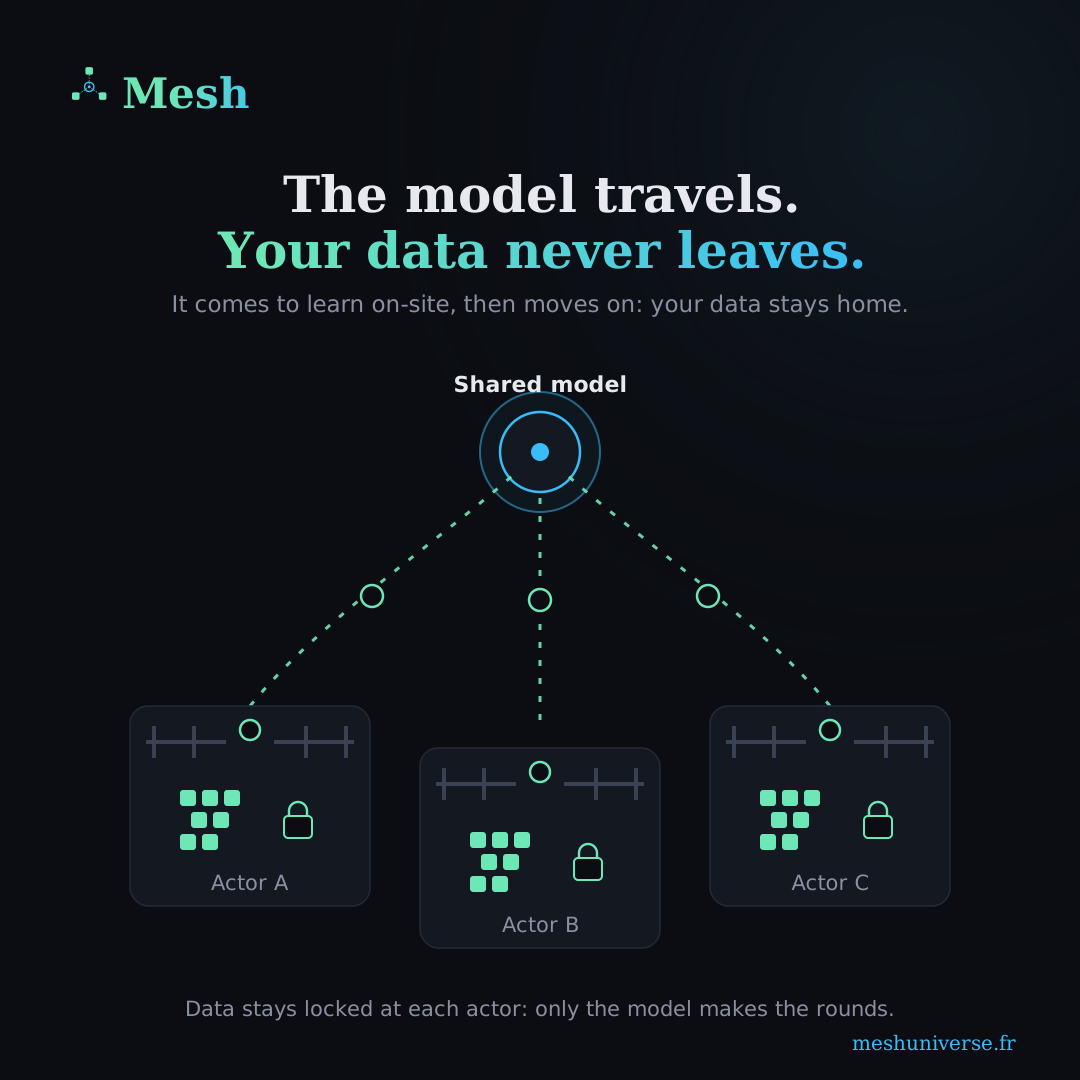
You train an AI without sharing your data thanks to federated learning: instead of sending your data to a central server, it's the model that comes to train at your place. You train it locally, on your own data, then you return only the result of that training, the model parameters, never the data. A coordinator combines the contributions of all participants to produce a shared model, better than each one's. At no point is your data copied, transferred or made readable to a third party. This is Mesh's principle: the model travels, your data stays home.
In practice: the 4 steps
To train an AI without sharing your data, the flow is always the same:
- You receive the model, not the other way around. A coordinator sends a copy of the current model to each participant, in an end-to-end encrypted envelope only you can open.
- You train at home. The model trains on your local data, inside your infrastructure. Nothing goes out. Your data rows are never even formatted to be sent.
- You return only settings. At the end, you transmit only the model update, a list of numbers (the weights), encrypted. These numbers describe what the model has learned, not what it has seen.
- The coordinator aggregates. It combines the updates of all participants (FedAvg algorithm) to produce a new shared model, which it will send back to you on the next round. We repeat until we get a good model.
Result: a model trained by the collective, without any data ever leaving anyone.
Why it works: what travels is not your data
The question that always comes up: "if the model learns from my data, doesn't it carry it away with it?"
No. What travels are model parameters, numerical coefficients. At Mesh, a typical update is a few hundred bytes: it's the setting of a model, not an excerpt of your data. None of your rows are ever serialized or transmitted (it's verifiable in the code: only the weights, the number of examples and the round metadata are serialized, never the training data).
Two protections are added depending on the level of requirement:
- End-to-end encryption (by default): even the infrastructure that carries the parameters cannot read them.
- Differential privacy (optional): calibrated noise is added to the parameters to prevent tracing back to an individual from the shared settings.
Do I have to trust the other participants?
You exchange nothing directly with the other participants. Each contribution is encrypted for the coordinator only; actors never see each other's data or models. Everyone keeps their data at home, in the clear, and shows it to no one, not even the coordinator.
What does it change concretely?
Training an AI without sharing your data unlocks situations that were impossible otherwise:
- Competitors can jointly improve a shared model without handing over their data. Everyone leaves stronger, no one exposed anything.
- Regulated data (health, banking, personal data) can serve to train a model without transfer, which helps with GDPR compliance (native minimization).
- An actor with a blind spot (it only measures part of reality) gets a model that "knows" things it has never observed, because others observed them in its place. Without ever accessing their data.
How to get started with Mesh
Mesh is a confidential federated learning platform. Depending on your situation:
- You want to join or start a consortium to train a shared model → The Collective.
- You hold a lot of data and want to be paid for its contribution without exposing it → Data Dividend.
- You want to understand the underlying technology → Federated learning and Confidential AI.
FAQ: Train an AI without sharing your data
Can you really train an AI without sharing your data?
Yes. Federated learning makes it possible: each actor trains the model on its own data, locally, and shares only the learned parameters, never the raw data.
What is sent, if not the data?
Only the model parameters (the "weights"): a list of numbers describing what the model has learned. At Mesh, these parameters are end-to-end encrypted; no line of data is ever transmitted.
Is it safer than anonymizing my data before sharing it?
It's a different and often more robust approach: rather than anonymizing then transferring (anonymization can be reversible), you don't transfer the data at all. It never leaves your infrastructure.
Can I train an AI with competitors without them seeing my data?
Yes: it's one of the main use cases. Participants exchange nothing directly; each keeps its data and shares only encrypted parameters.
Does the final model belong to me?
You can pick up the trained engine, run it at home and fine-tune it privately on your own data. The precise governance of the collective model (each contributor's rights) is defined within the consortium framework.
Let's see it on your data
An interactive demonstration is available on request: we'll give you access.