Federated environmental footprint: complete an inventory without sharing one
A federated environmental footprint answers a concrete problem: to compute a credible impact you need a complete life-cycle inventory, but each actor in a value chain only meters part of the flows, and cannot expose its inventories to competitors. In this proof of concept, Mesh (Mesh Universe) shows how a consortium trains, by federated learning, an estimator of the missing flow that each member runs at home to fill its gap, without sharing any inventory. The footprint is then computed deterministically, with real, public EF characterisation factors.
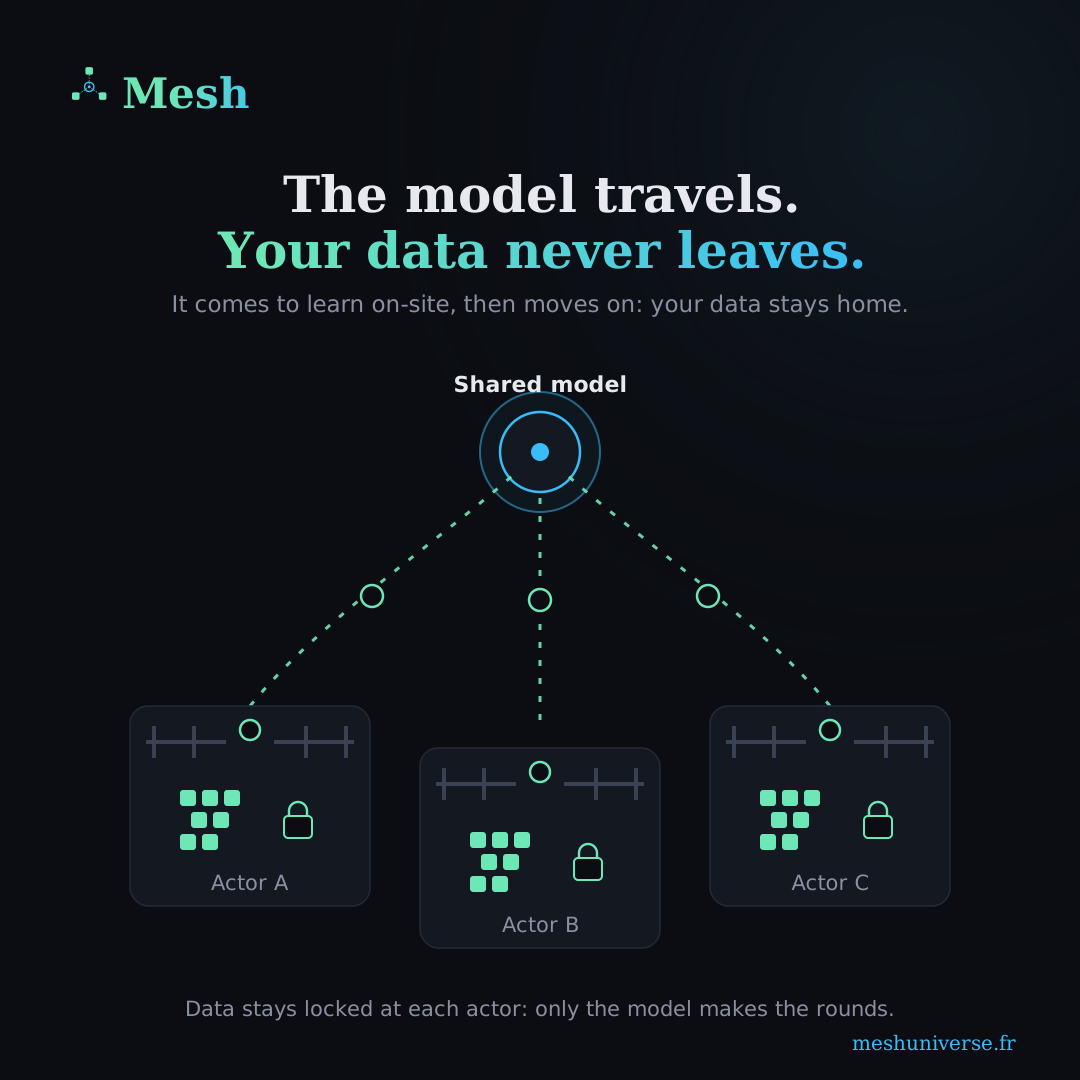
The model travels, inventories stay home.
The problem: holed inventories
A life-cycle inventory (LCI) is the list of a process's elementary flows: energy, emissions, materials. In practice, every plant has a holed inventory: it continuously meters some flows and estimates or omits others. Yet the missing flows are exactly what a credible footprint needs. A plant on its own is myopic; the collective together has metered every flow, but the inventories cannot be pooled (trade secrecy, competition).
What the demo does
The proof of concept runs in three acts:
- An estimator of the missing flow, nothing more. The federated model learns to impute a missing inventory quantity (here fine particulate matter, PM2.5) from the flows a plant does measure. It's a regression: we report an error (RMSE / MAE), never an "accuracy". The model is never retained by Mesh.
- Each plant completes its inventory at home, with an uncertainty band around the imputed value: we also show the empirically measured coverage of that band, hiding none of the assumptions.
- The footprint is computed separately, deterministically: completed inventory × characterisation factors → impact scores. The AI never computes the footprint; it only imputes the missing flow. The impact calculation itself can be recomputed by hand.
Throughout, nothing leaves each plant: only encrypted model parameters are exchanged (FedAvg aggregation). → see Federated learning: definition and how it works.
What is real, what is synthetic
The demo clearly separates the two:
- Synthetic: the plant inventories. Six fictitious sites (aluminium, copper, zinc), fully synthetic inventories, fixed seed (reproducible), calibrated to public orders of magnitude. These are not customer data.
- Real: the footprint calculation layer. Impact scores are computed with the real characterisation factors from the Environmental Footprint (EF 3.1) reference package published by the European Commission's Joint Research Centre (JRC), under CC BY 4.0, reused with attribution. Factors we could not fully verify are explicitly flagged "illustrative / to-be-sourced" rather than presented as official.
No licensed data (commercial metals inventories) is used: only public, open datasets were consulted, and only to set orders of magnitude.
Demo vs target architecture
What the demo actually runs, versus what a production deployment would be:
| The demo (today) | Target architecture (production) | |
|---|---|---|
| Aggregation | FedAvg run in the clear in the back-end | aggregation inside a Secrecy confidential-compute enclave, offered as an option |
| Inventories | synthetic, seed 42, reproducible | each member's real inventories, never leaving their site |
| EF factors | real where flagged (CC BY 4.0), else marked illustrative | full EF package, sourced and attributed |
| Model | linear regression (imputes a missing flow) | hardened estimator, audited differential-privacy budget |
In other words: the demo proves the mechanism (impute a flow by federation, then compute the footprint verifiably), and explicitly names what would remain to be hardened for a pilot on real inventories.
How to see the demo?
The interactive demo is provided on request, with named access. Email us with your value chain; we show you the mechanism and discuss what a pilot on your inventories (which would never leave your site) would involve.
FAQ: Federated environmental footprint
Can you compute a footprint without sharing your data?
Yes, through federated learning. An estimator of the missing flow is trained by the collective; each actor runs it at home to complete its inventory, then the footprint is computed deterministically with real, public EF factors. No inventory is shared.
Is it a finished product or a demo?
A mechanism demonstration (proof of concept), not a customer result nor a compliance tool. It illustrates the target architecture: local training, only encrypted parameters travel.
Is the data real?
The plant inventories are synthetic (reproducible). Only the calculation layer uses the real characterisation factors from the European Commission's EF package (CC BY 4.0). We never present synthetic inventories as customer data.
Is it built for one specific customer?
No. Metals is an illustrative context; Mesh is a generic federated learning engine, applicable to other value chains. → see The Collective.
How do I see it?
On request, with named access: use the contact form.
See the mechanism on your value chain
Named access on request: a mechanism demonstration, then a discussion of a pilot on your inventories (which never leave).